SKU: 7569690743
pot plants with 9 leaves

pot plants with 9 leaves Cloud 9 Dogwood – Plant Detectives

Sale price$18.15 Regular price$20.17
Save 10%

Pay in installments of $5.04 with ShopPay, AfterPay and Klarna

Shipping Estimate
USA
  • USA
  • CAN

Ships within 48 hours · Estimated delivery Oct 17 - Oct 22

Promo Codes Available:

For Your Every Summer RSVP, with Code: SUMMER15

Description

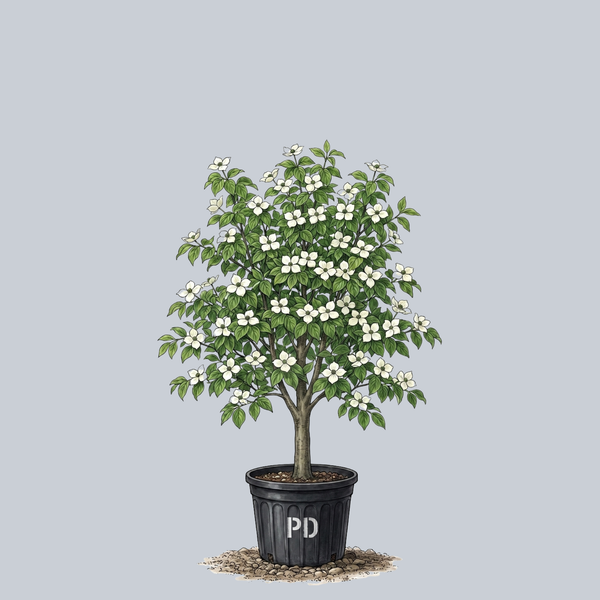
pot plants with 9 leaves Cloud 9 Dogwood – Plant DetectivesCloud 9 Dogwood (Cornus florida 'Cloud 9') Cloud 9 Dogwood is a classic white flowering selection of native flowering dogwood valued for its abundant spring blooms, graceful branching, and strong seasonal appeal. Its showy white bracts often appear heavily even on younger trees, giving the landscape a bright, clean display early in the season. After flowering, green foliage carries the tree through summer before turning rich red to red purple in fall.

Cloud 9 Dogwood (Cornus florida 'Cloud 9')

Cloud 9 Dogwood is a classic white-flowering selection of native flowering dogwood valued for its abundant spring blooms, graceful branching, and strong seasonal appeal. Its showy white bracts often appear heavily even on younger trees, giving the landscape a bright, clean display early in the season. After flowering, green foliage carries the tree through summer before turning rich red to red-purple in fall. With its manageable size and layered form, Cloud 9 Dogwood is well suited for front yards, woodland edges, mixed borders, and smaller ornamental tree plantings.

Distinctive Features

Cloud 9 Dogwood is known for its profuse white spring bracts, which are often broad, overlapping, and larger than those of many seed-grown flowering dogwoods. The tree develops a small deciduous canopy with a short trunk, layered horizontal branching, and a rounded to spreading habit with age. Medium green leaves provide a clean summer look before shifting to shades of rust-red, red, or red-purple in autumn. Bright red fruit may develop in late summer to fall, adding ornamental interest and providing a seasonal food source for birds.

Growing Conditions

  • Sun: Grows best in partial sun to partial shade, with morning sun and afternoon shade especially helpful in hot or exposed sites.
  • Soil: Prefers fertile, acidic, well-drained soil with good organic matter and steady root-zone moisture.
  • Water: Performs best with medium, even moisture, especially during establishment, drought, and periods of summer heat.
  • USDA Zones: Hardy in USDA Zones 5 to 9.
  • Mature Size: Typically reaches about 15 to 30 feet tall and 15 to 30 feet wide, often staying toward the smaller end in many landscape settings.
  • Habit: Forms a small deciduous ornamental tree with layered horizontal branching and a rounded to broadly spreading canopy.

Ideal Uses

  • Focal Point: Use as a spring-flowering focal point in front yards, entry gardens, courtyard plantings, or small lawn areas where its white bloom display can stand out.
  • Woodland Edge: Plant along woodland margins or lightly shaded garden edges where it can receive filtered light and consistent moisture.
  • Mixed Border: Add to layered shrub and perennial borders for spring flowers, fall color, wildlife value, and elegant small-tree structure.
  • Foundation Planting: Use near larger homes or broad foundation beds where a smaller ornamental tree can soften architecture without overwhelming the space.
  • Wildlife Garden: Include in bird-friendly landscapes where its red fruit can support seasonal wildlife activity.

Low Maintenance Care

  • Watering: Water deeply during the first few seasons and during dry periods to maintain even moisture without keeping the soil saturated.
  • Mulching: Apply a broad mulch ring to conserve moisture, moderate soil temperature, and reduce competition from turfgrass.
  • Pruning: Prune lightly during dormancy or after flowering to remove dead, damaged, crossing, or crowded branches while preserving the natural layered form.
  • Fertilizing: Fertilize only when needed based on soil conditions, avoiding excessive nitrogen that can encourage weak or overly soft growth.
  • Deer Protection: Protect young trees from browsing and trunk rubbing in landscapes with moderate to heavy deer pressure.
  • Site Care: Provide good air circulation, avoid planting too deeply, and keep mulch pulled back from the trunk to support long-term health.

Why Choose Cloud 9 Dogwood?

  • Abundant Blooms: Produces a heavy display of white spring bracts that can appear generously even on younger trees.
  • Classic Dogwood Form: Develops the graceful layered branching and small-tree structure that make flowering dogwood a landscape favorite.
  • Seasonal Interest: Offers spring flowers, clean summer foliage, red to red-purple fall color, and possible red fruit for birds.
  • Manageable Size: Fits residential landscapes where a smaller ornamental tree is more practical than a large shade tree.
  • Native Character: Brings the familiar beauty and ecological value of flowering dogwood into designed garden spaces.

Cloud 9 Dogwood is an excellent choice for gardeners who want a dependable white-flowering dogwood with strong spring presence and classic native character. Its abundant blooms, graceful branching, fall color, and bird-friendly fruit make it a valuable ornamental tree for well-sited landscapes with good soil, steady moisture, and room to develop naturally.

Shipping Notes
  • Free Standard Shipping on $100+ Orders to the USA.
  • Except Preorder products are shipped in 48 hours.
  • Delivery to the USA:
  1. Standard Shipping : 3-10 business days
  • If time is of the essence, please consider selecting expedited delivery for faster service.
Exchange/Return Notes
  • We offer a 30-day return/exchange service after receiving.
  • Final sale items are not eligible for returns or exchanges.
  • To process your return/exchange, please contact us at [email protected]
  • Please click here for more details>>> Return & Exchange Policy
SKU: 7569690743

Discover Niche Categories That Outsell pot plants with 9 leaves

Top-Converting Item to Boost Your Average Order

4.2 ★★★★★
Based on 10 reviews
Sort
Highest Rating
Newest First
Oldest First
Product Reviews
R
Verified Purchase
Rod Sullivan
Belleville, US
★★★★★ 5
Like Having an Expert Looking over Your Shoulder
I am a law professor who spent 25 years as a Plaintiff's lawyer before deciding to teach. I've been before the U.S. Circuit Courts of Appeal many times and state appellate courts a few times. One caveat to consider: I expect to be arguing before the United States Supreme Court in the future. I hesitate to be too ebullient, lest you think that I'm trying to curry favor. However, I think that this book is great. Why do I recommend it? First, it is short. This book will accomplish much of what other books try to teach about advocacy, but in many fewer pages. Secondly, it is practical. It teaches writing skills, speaking skills, and how to be persuasive with limited time. Finally, it is not just for lawyers. Anyone trying to be persuasive can apply the same skills to other situations. For those of you who are politically opposed to Justice Scalia (which, believe it or not, includes some law professors)this is a joint effort by Garner and Scalia, and they frequently disagree. Hearing both sides of the argument on how to write or speak persuasively will help you decide how you want to present your arguments. How do my political opinions and Justice Scalia's opinions mesh? Can I be fair? I think so. He's a Federalist, I consider myself an Anti-Federalist. He as supporter of administrative delegation, I think delegation of congressional responsibilities to administrative agencies is congressional abdication. In short, I'm not recommending this book because Justice Scalia and I agree on policy, because on many policy matters we don't. I'm recommending it because I think it will help you. You wont be disappointed with the book.
WAS THIS REVIEW HELPFUL?YesReportShare
Reviewed in the United States on January 29, 2009
X
Verified Purchase
xiwaeo
Battle Creek, US
★★★★★ 5
Great Read
Great book, I enjoyed reading it. I am non-lawyer so I spent time having to read and re-read sentences and paragraphs but darn good book. Highly recommend it. Sometimes a person can be in discussion with an official, doctor, lawyer, cop ..whatever--it helps to remember arguments made in this book. Most folks just try to explain a situation, heaven forbid standing in front of a court or judge in a legal matter. But, this type of reading builds confidence, a strong vocabulary and so forth. It matters most trying to persuade a person or an institution..just winning, making your point in a clear coherent and cognizant way. This book can teach you these things.
WAS THIS REVIEW HELPFUL?YesReportShare
Reviewed in the United States on June 20, 2025
J
Verified Purchase
Jeff Wade
Bozeman, US
★★★★★ 4
You don't have to like Justice Scalia to like his book.
Perhaps an appellate brief that you wrote would have been perfect if only the judge had read it. The lesson you learned, hopefully, was that there is no guarantee that a judge will read your brief. The lesson you can learn from "Making Your Case" is how to write so that the judges will read what you wrote - preferably before your oral argument. Writing in a quite candid, lucid and entertaining style, Scalia and Garner serve up tips that even the most experienced lawyers can learn from. If you find yourself approaching the court's word limit, for example, you may be minimizing the chances of having your brief read, as judges really do favor brevity. How do you write for a court that is notoriously dismissive of higher court precedents? How do you best respond to a judge who asks whether you would be content with a remand? These and other critical questions are addressed simply yet insightfully. If your legal education stressed the IRAC approach (Issue, Rule, Application, Conclusion), Scalia and Garner take you a step further by stressing a syllogistic approach. Even if you have already been exposed to all the best ideas about persuading appellate judges, you are still likely to gain much rom reading "Making Your Case" because the authors organize all those ideas in a way that makes them much easier to remember and keep them in mind as you prepare your written and oral arguments. Justice Scalia calls his approach to legal reasoning and argument "textualism," which I understand to mean that his decisions are driven by the language of the law and of the case. My impression from reading many of his decisions is that he is often driven by ideology, so I can't quite square his book with his decisions. I also question the book's fundamental statement that the overriding objective of a brief is to make the court's job easier, as I prefer to write primarily for the purpose of winning the case. My criticisms of "Making Your Case" are miniscule compared to those thrown at it by Richard Posner. But although I find Judge Posner's decisions generally more fair than those of Justice Scalia, I prefer the clarity of Justice Scalia's writing - especially when he teams up with Bryan Garmer. Judge Posner notwithstanding, Scalia and Garner have put together a gem that is likely to prove invaluable for law students as well as for trial and appellate lawyers who are still interested in improving their game. If you fall into either category, buy this book, read it two or three times, and then keep it handy as a reference. It should help you make your case.
WAS THIS REVIEW HELPFUL?YesReportShare
Reviewed in the United States on December 18, 2012
F
Verified Purchase
Fig&Friday
Bozeman, US
★★★★★ 5
A Great Read... (for those in the legal field)
A great gift for those in the legal field. We ordered several for gifts throughout the year.. Made a great little gift basket with a bottle of whiskey :)
WAS THIS REVIEW HELPFUL?YesReportShare
Reviewed in the United States on January 20, 2026
R
Verified Purchase
rbnn
New York, US
★★★★★ 5
Elegant, useful
Simply the best book on legal persuasive writing ever written. Interesting, useful, fun, full of great anecdotes. Terrific discussion of statutory interpretation. Great references to scholarly classical treatises on rhetoric. This book is wonderful both for its analysis of oral argument and for its discussion of written forms of persuasion, like briefs. I wish I had had it earlier. My only complaint is the same one I have with virtually all modern style manuals: they advocate a simplistic prose style, characterized by short, conversational sentences, avoiding unusual words, eschewing Latin phrases. But I personally often find prose that breaks these rules a refreshing change. I enjoy reading a word or phrase I rarely see but that is perfectly chosen. And I enjoy learning new words or phrases. This book would condemn two of the greatest legal prose stylists out there: John Marshall and Learned Hand, both of whose opinions often contained sentences that would not work so well conversationally, that were full of long, convoluted sentences and classical allusions. My sense is that in this joint work Justice Scalia, who can write rich and interesting prose, pushed back against some of the simplifying strictures of his co-author. Furthermore, I think that often too much emphasis on simple words and sentences serves to make more complex ideas too difficult to express or to understand. Thus, the book (like most books) argues against "jargon," but jargon, once learned, is often a much clearer way of expressing something than a rephrasing. And the Roe v. Wade anecdote is great! It explains a lot... In any case, I am hardly qualified to criticize Justice Scalia, whose writing is far beyond my own. Anyway, this is a great book.
WAS THIS REVIEW HELPFUL?YesReportShare
Reviewed in the United States on May 7, 2008

recommand products